Days of Sacred Flight
Last and First MenDays of Sacred Flight were recurring festivals of the First Men in which the sky became a vast arena of worship. Thousands of aircraft performed intricate patterns above religious centres, making visible the age’s conviction that movement was divine and that flight was its most exalted expression.
Religious and social foundations
The festivals arose from the First Men’s worship of movement, embodied in Gordelpus, the god of motion. Religious teaching held that each person owed this power swift and intricate activity, and that eternal life depended on fulfilling the obligation. Flight carried particular authority: it served as vital communication and the swiftest form of travel, while also representing the supreme act of worship.
Aviation’s sacred standing was reinforced by both symbol and circumstance. The aeroplane recalled the principal symbol of ancient Christianity, whose forms survived even after its original spirit had been lost. And since warfare had ceased, dangerous aerial performance offered a major outlet for human adventurousness. Young people risked their lives in flight for religious glory and personal salvation; older spectators found vicarious satisfaction in their displays of prowess.
The festival in the sky
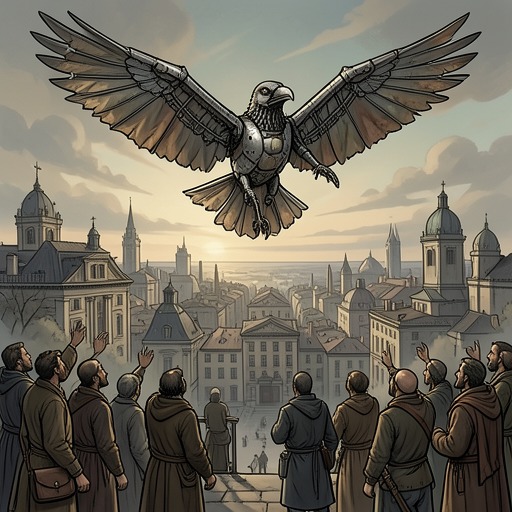
On frequent Days of Sacred Flight, each religious centre held communal and solo aviation rituals. Thousands of planes filled the sky at different altitudes, wheeling, tumbling, soaring, and plunging in an ordered composition. The movements at one level complemented those at others, producing a collective dance that combined many separate formations into a single evolving design.
The mass performance gave way to individual virtuosity: the formations suddenly dispersed toward the horizon, opening the sky to quartets, duets, and solo flights by celebrated pilots. Night extended the spectacle in another form, as regiments of aircraft bearing coloured lights traced changing symbolic patterns overhead. For eight hundred years, a related custom had periodically used a dense formation six thousand miles long to spell out the sacred rubrics of the gospel of Gordelpus, making its words visible from afar.
Flight beyond the festival
The festival was the most conspicuous expression of a practice that structured individual life as well as communal worship. Flight began as a religiously marked experience in infancy; at adolescence, each person took charge of an aircraft for the first time, and later faced severe aeronautical tests. Even in old age, when advancement in active flight was no longer expected, daily flying continued for practical purposes.
This constant participation helps explain why the festival mattered beyond its spectacle. Flight joined religious duty to communication, technical work, youthful status, and shared public ritual. The narration presents devotional aerial acrobatics as one reason the First Men preserved peace and social unity for so long: competing performances were made parts of a single, carefully coordinated design.
Science, religion, and public order
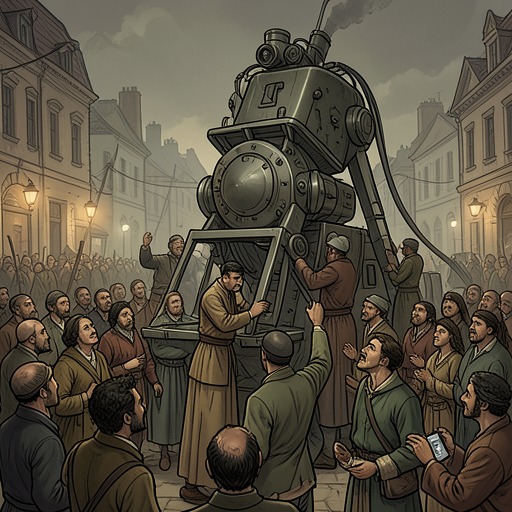
The ceremonies belonged to a culture in which scientific achievement carried exceptional prestige because its applications had transformed material life. Scientific workers were regarded as embodiments of power, while the Sacred Order of Scientists held a privileged position. Under the movement cult, the measurement and recording of motion could itself be understood as a way of preserving the transient within the eternal order of Gordelpus.
That religious framework also accommodated apparently different traditions. At a conference convened more than two centuries after the formation of the First World State, religious leaders agreed that their differences were differences of expression: divine energy could appear as activity or as tense stillness. The Days of Sacred Flight gave this broad doctrine a concrete civic form. Their ordered aerial choreography made worship public, collective, and technically exact, turning the sky into an image of a society striving to reconcile individual feats with a single social order.